Click here to register on Zoom.
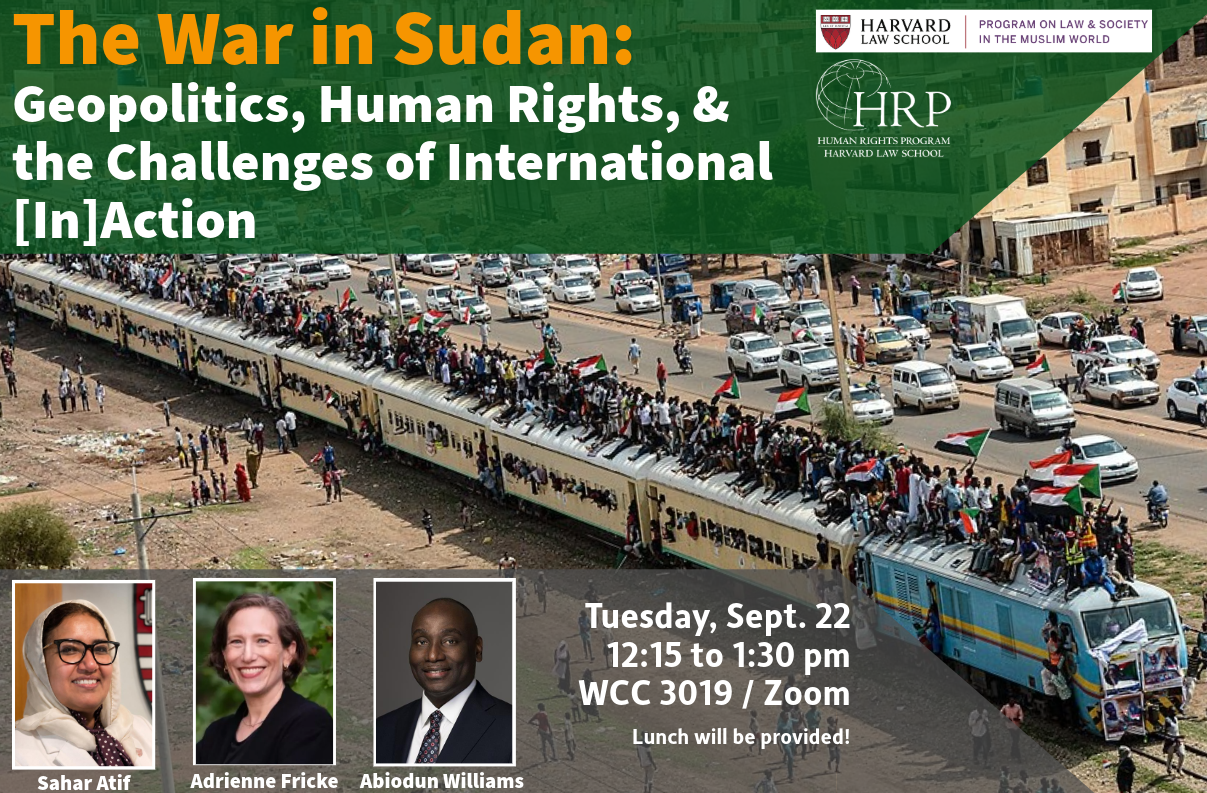
Sudan’s ongoing conflict has precipitated a catastrophic humanitarian and human rights crisis, violently reversing the country’s democratic transition and devastating civilian life. The crisis presents profound challenges not only for domestic political order, but also for the security of the Sahel and the Horn of Africa, as well as for broader international community. As the violence continues to evolve, understanding the complex, interlocking dynamics on the ground is critical to identifying potential pathways toward stability.
This panel will provide a comprehensive update on Sudan’s current political and humanitarian conditions before zooming out to analyze the broader international dimensions of the war. Speakers will examine the geopolitical forces, shifting global power dynamics, and external interests shaping the conflict. Finally, the discussion will critically evaluate the diplomatic and multilateral response, focusing specifically on the institutional roles, efficacy, and limitations of the United Nations and the African Union.
Lunch will be provided!
Panelists
Sahar Atif is a Sudanese attorney, human rights activist, Harvard Kennedy School graduate, Mason Fellow, Public Service Fellow (Class of 2026), and recipient of the Eric Yankah Award. Displaced by the war that erupted in Sudan in April 2023. She has actively advocated for Sudan during her time at Harvard, speaking at the Institute of Politics, Harvard Law School, and the UN Commission on the Status of Women. She has taught at two universities in Sudan and continues to advocate for Sudanese women, human rights, and efforts for peace.
Adrienne Fricke is a Fellow with the Harvard Kennedy School’s Middle East Initiative and a member of its Syria Transition Lab, where she studies governance and transitional justice. Her interdisciplinary scholarship draws from the fields of law, social science, and international development to address policy issues in the Middle East and Africa, with a particular focus on Syria and Sudan. Since 2007, she has worked with non-governmental organizations including Refugees International, Physicians for Human Rights, and the Institute of International Education.
Abiodun Williams is a scholar-practitioner who has served at the UN as Director of Strategic Planning for Secretaries-General Kofi Annan and Ban Ki-moon and previously held senior political and humanitarian roles in peacekeeping missions in North Macedonia, Haiti, and Bosnia-Herzegovina. He later served as President of The Hague Institute for Global Justice and held leadership positions at the United States Institute of Peace. Most recently, Dr. Williams was Professor of the Practice of International Politics at The Fletcher School of Law and Diplomacy and The Jonathan M. Tisch College of Civic Life at Tufts University, where he also directed the Institute for Global Leadership.
Abadir Ibrahim (moderator) is the Associate Director of the Human Rights Program at Harvard Law School. His current research focuses on African approaches to human rights which studies, among other things, the iteration and practice of human rights as impacted by Africa’s (post)colonial, religious and traditional heritages.
This event is co-sponsored by the Human Rights Program at Harvard Law School and the Program on Law & Society in the Muslim World.