A Dead Constitution: How Sudan’s Legal Guardrails Were Dismantled and Why War Was the Natural Trajectory
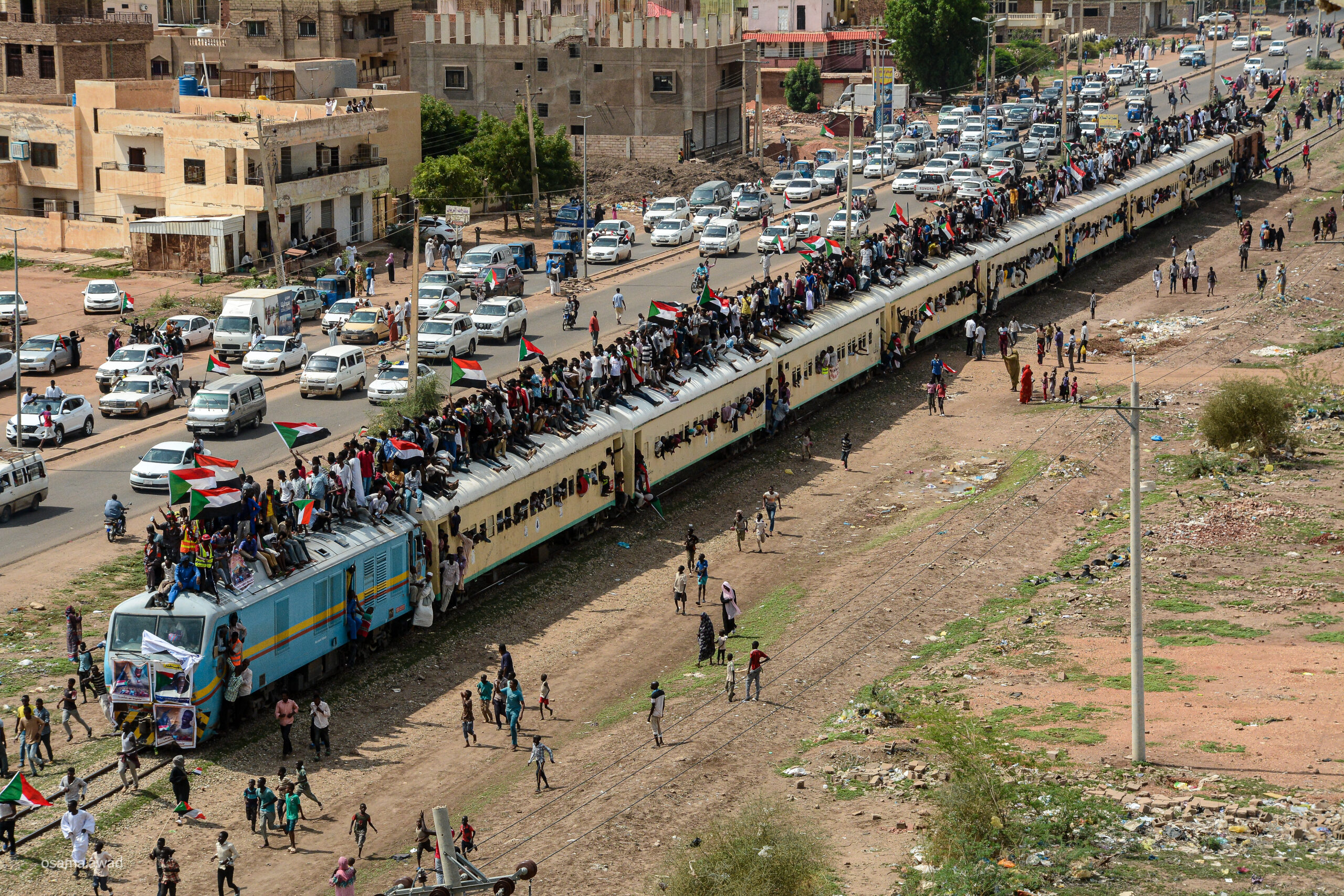
Rubbing my face with all my might, raising my head just to breathe, I am running as fast as I can. The galloping of the crowd kicks sand into my eyes. Through the white smoke of tear gas and the sound of live bullets, police chase us through the streets of Buri, Khartoum. Dead bodies fall from the crowd of peaceful protesters, shot by government snipers.
Why?
Why would someone leave the safety and comfort of their home and risk their life under one of the fiercest authoritarian regimes? Why did so many of my fellow citizens and I do so, not once or twice but consistently, despite the risk and knowledge that our chances of succeeding were almost nil? And why would the government respond with such lethal force?
The answer is simple: it was the only moral response to an injustice that had reached a saturation point—unbearable to carry in silence any longer. For many, there was not much left to lose. A few names to give context: Ahmed El Kheir, a teacher who was tortured to death in an intelligence detention center in Kassala. Siti Alnfor, a 24-year-old female nurse, shot by security forces during a peaceful demonstration against the military coup of October 2021. Mohamed Magdi Taha, a 21-year-old MIT undergraduate, shot by an intelligence service guard outside the intelligence social club during a school break in 2022. Mohamed Mattar, a 26-year-old engineer, killed among hundreds during the June 3, 2019, massacre when security forces violently dispersed the peaceful sit-in outside the military headquarters—he died attempting to shield two women from gunfire.
Freedom of speech, peaceful assembly, accountability, equality before the law—no constitution was alive to protect any of them. The constitution died before they did and left their families with nothing but grief and the silence of an unaccountable power.
Some constitutions have remained untouched for centuries. Changing a single article requires a referendum or a parliamentary supermajority. In the case of others, the process is far simpler: a decree suffices. Constitutions become instruments of convenience, amended to consolidate power, extended to prolong a ruler’s grip, and frozen wherever they inconvenience the regime. What dictators rarely understand is that in dismantling these legal guardrails, they are not securing their power. They are writing the death warrants of their own states.
What is often overlooked is that constitutional erosion is not merely a governance failure, but rather a legal catastrophe with measurable, predictable consequences. I argue in this piece that when constitutional guardrails are intentionally dismantled, state collapse is not a possibility, but a trajectory. The indicators are traceable, the pattern is consistent, and the destination, if left unaddressed, is war. I believe that if there were a physical “legal state collapse thermometer,” a measurable, structured framework to track the systematic removal of constitutional guardrails in real time, nations could be saved. Sudan’s tragedy is precisely the case that makes this framework necessary. But its application extends far beyond.
Sudan’s Constitutional History: Seventy Years of Constitutional Performance
Tracing Sudan’s constitutional history across its seventy years of independence reveals that the constitution was never guarded as the supreme law of the land. It kept changing and adapting to fit the tastes and interests of the rulers, rewritten repeatedly to serve the ideological and political interests of successive regimes—a pattern meticulously documented by Mohammed Abdelsalam Babiker and Atta H. el-Battahani in their seminal paper, “Reflections on Sudan’s Constitutional Trajectory.”
In seventy years, Sudan produced seven constitutions: 1956, 1964, 1973, 1985, 1998, 2005, and 2019. Not one of them survived as a permanent, living document. Each was suspended, replaced, or amended by decree whenever it became inconvenient to those in power. This was not constitutional governance. It was constitutional performance, a facade of legitimacy erected for international audiences while the actual business of power was conducted elsewhere, by other means.
The limited public awareness of the constitution’s vital role as the supreme law of the land is itself part of Sudan’s dilemma—and authoritarian regimes have consistently leveraged it. A telling illustration: rarely in Sudan’s history have mass demonstrations erupted over constitutional violations. The streets fill when bread prices rise or fuel becomes unaffordable. The slow dismantling of legal guardrails passes in silence.
Sudan’s first constitution of 1956 was a transitional document that was never replaced by a permanent one before the first military coup was launched in November 1958 by General Abboud, who suspended it entirely. The October Revolution of 1964 that toppled Abboud produced a new constitutional framework, itself short-lived. In 1969, General Gaafar Nimeiry seized power by military decree, dissolved the constitution, and produced the 1973 permanent constitution. He then subverted the same constitution in its entirety when he shifted from the left to the right, from socialist to Islamist ideology. He imposed the infamous September Laws of 1983, which declared Sharia as the supreme law of the land overnight without input from parliament, without a referendum, and without the consent of the people.
What followed was unlike anything Sudan had seen. Nimeiry selectively invoked a highly restrictive interpretation of Sharia through the enactment of the so-called September Laws of 1983. He banned alcohol and implemented hudud punishments, including public flogging and cross-amputations for theft. I still recall evenings as a child when the entire family gathered around the television, listening carefully as the names of individuals who would face cross-amputation the following day were publicly announced. Before that, screens showed mountains of confiscated alcohol bottles being smashed in public. Few quarreled with the principle, as alcohol prohibition sits comfortably within Islamic tradition and the beliefs of most residents. But this was something else: ideological performance par excellence, dressed as justice. Everyone watched. Everyone listened. The constitution was silent. It had not protected a single one of the victims.
The April Intifada of 1985 ended Nimeiry’s sixteen-year rule, ushering in a brief transitional period. Elections followed in 1986, bringing a civilian government under Prime Minister Sadiq al-Mahdi.
That fragile democratic opening lasted barely three years before Omar al-Bashir’s coup of 1989 brought the National Islamic Front to power—a regime that would rule for three decades. His first decree was to freeze the constitution, declare a state of emergency, and consolidate all executive and legislative powers in the hands of one man. After nearly ten years of governing by decree, Bashir’s regime produced the 1998 constitution, later replaced in 2005 by the Interim National Constitution, negotiated as part of the Comprehensive Peace Agreement to end the catastrophic North-South Civil War.
Same Dilemma on Repeat: Revolution, Military Coup, Revolution
The revolution of 2018 toppled a dictator who had ruled for thirty years—but the Islamist deep state never truly left. The 2019 Constitutional Document was supposed to guide a three-year transition ending in democratic elections. But the short-lived transitional government was hijacked by a military coup in October 2021, orchestrated by two generals—Burhan of the army and Hemedti of the Rapid Support Forces—who later turned on each other. The magic, as the Arabic expression goes, turned on the magician.
On April 15, 2023, war erupted. Whatever its precise trigger, the conditions had been built over decades of constitutional erasure. Women’s bodies became battlefields. Cities were destroyed. Education collapsed. Over thirty million people—including myself—were displaced in what the United Nations declared the largest humanitarian crisis in the world, with an estimated 400,000 lives lost in Darfur alone, according to the U.S. Special Envoy.
As a regular protestor in the streets of Khartoum fighting for democracy, freedom, and justice, I always expected—as did others—that I might not return home alive. At the end of every demonstration, the casualty numbers were devastating, I thought that was the worst-case scenario.
What my imagination failed to capture was that I could become a refugee from a collapsed state and an active war, with thousands killed and displaced.
If only there had been a public reckoning—a real, lived awareness of what the slow death of a constitution leads to, not just among lawyers and scholars, but in the streets, homes, and schools. If citizens had known that every suspended clause, every decree that replaced a vote, and every constitution buried without ceremony was raising the temperature toward collapse, perhaps the rising thermometer would have alarmed us before the war did. Perhaps the genocides of Darfur, the documented use of rape as a weapon of war, and the collapse of an entire nation could have been prevented.
Nations need to believe in the power of constitutions and in the power of the rule of law—because when the law is silenced, the people are next.
Sahar Atif is a Sudanese attorney, human rights activist, Harvard Kennedy School graduate, Mason Fellow, Public Service Fellow (Class of 2026), and recipient of the Eric Yankah Award. Displaced by the war that erupted in Sudan in April 2023. She has actively advocated for Sudan during her time at Harvard, speaking at the Institute of Politics, Harvard Law School, and the UN Commission on the Status of Women. She has taught at two universities in Sudan and continues to advocate for Sudanese women, human rights, and efforts for peace.
Views expressed on Harvard Human Rights Reflections are those of the individual authors and do not necessarily reflect the opinions or positions of the Human Rights Program or Harvard Law School.