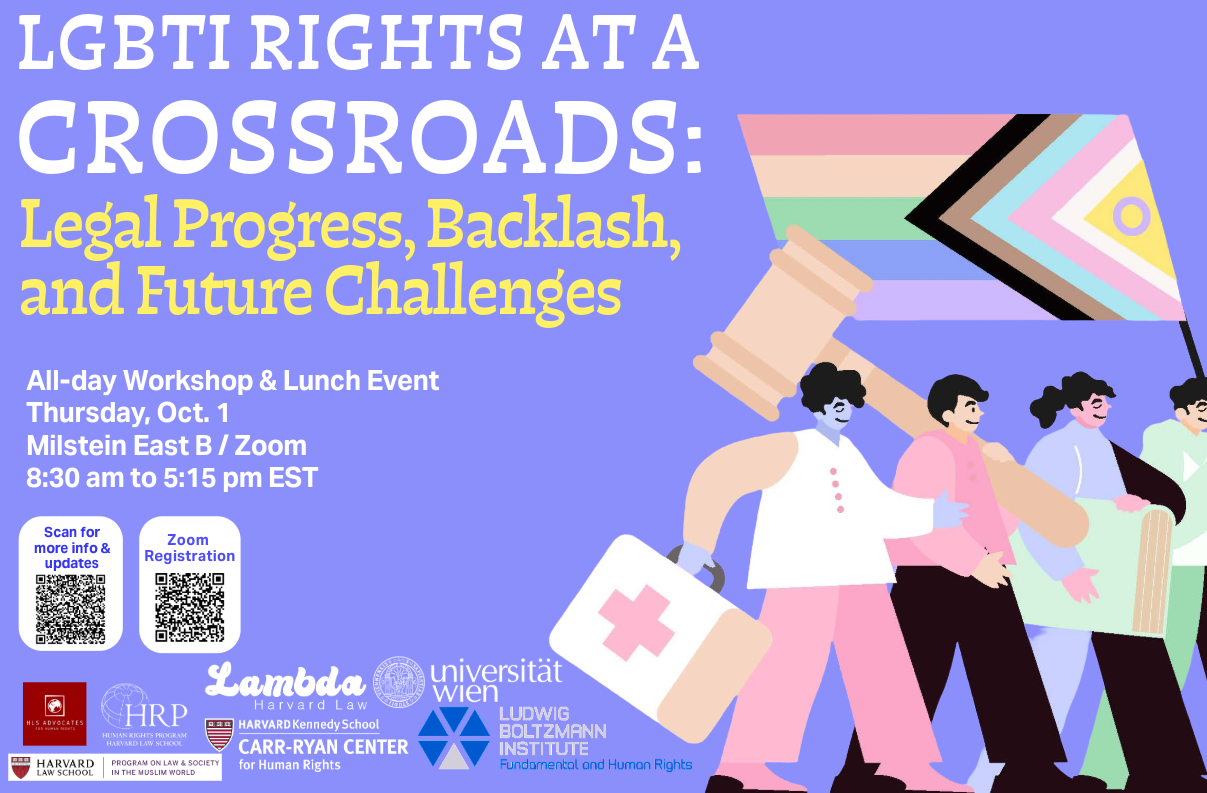
This event will be open to the public at Harvard Law School, as well as livestreamed. Click here to register for Zoom.

Over the past decades, the recognition and protection of LGBTI rights has undergone a remarkable transformation. Issues that were once excluded from legal and political debates have gradually moved to the center of human rights discourse, and landmark judgments, legislative reforms, and social movements have contributed to the decriminalization of same-sex relationships, the recognition of diverse family forms, and stronger protections against discrimination. Yet, these achievements cannot be taken for granted, as recent years have witnessed a growing backlash against LGBTI rights in many parts of the world, with attempts to restrict existing protection mechanisms, challenge equality measures, and question the universality of human rights. Against this background, the legal protection of LGBTI persons remains one of the most pressing and contested human rights issues of our time.
The resulting body of law, far from being a single, uniform whole, reflects a plurality of legal traditions, cultural contexts, historical experiences, and social realities. Using the Oxford Handbook of LGBTI Law (2026) as an organizing framework and a point of departure, this one-day workshop will bring together contributors to the Handbook, as well as other participants from academia and civil society, to examine key developments and challenges in the field of LGBTI law. Selected authors will present insights from their chapters and engage in discussions on specific aspects of LGBTI rights protection, ranging from international and regional human rights frameworks to emerging debates and future challenges. The workshop aims to provide a platform for exchange, critical reflection, and dialogue on the future direction of LGBTI rights in an increasingly contested global environment.
Schedule
8:30-8:45
Welcoming Remarks
Gerald L. Neuman
J. Sinclair Armstrong Professor of International, Foreign, and Comparative Law, as well as Director of the Human Rights Program
Michael Lysander Fremuth
Co-Editor of the Oxford Handbook on LGBTI-Law; University of Vienna; Director of the Ludwig Boltzmann Institute of Fundamental and Human Rights
8:45-10:15 | Panel 1
Foundations of LGBTI Law: Concepts, Equality, and Legal Transportation
Moderator: Victor Madrigal-Borloz
Former UN Independent Expert on Sexual Orientation and Gender Identity; Lecturer on Law, Harvard Law School
Jessica Stern: The role of diplomacy in legal and policy transformation
Harvard Kennedy School’s Carr-Ryan Center for Human Rights
Elisabeth Holzleithner: Sexuality, Gender, and the Law: Queer Relations
University of Vienna
Andreas Ziegler: SOGIESC as an area of studies in international and comparative law
– is it necessary, is, is it worthwhile?
Co-Editor of the Oxford-Handbook on LGBTI-Law, University of Lausanne
Berta Esperanza Hernández-Truyol: Rites vs. Rights: Awakening to Tensions Between LGBT Rights and Religious Liberty
Co-Editor of the Oxford-Handbook on LGBTI-Law, University of Florida Levin College of Law
10:15-10:30
Break
10:30-10:45
Interlude
Samantha Power: Making Change When Change is Hard: Lessons on LGBTI Rights from US Foreign Policy
Harvard Kennedy School/Harvard Law School
10:45-12:15 | Panel 2
Regional Perspectives on LGBTI Law: Diversity, Progress, and Backlash
Moderator: Daniel Levine-Spound
Lecturer on Law, Harvard Law School; International Human Rights Clinic
Suhail Abualsameed: Whose Language, Whose Rights? Sexuality and Gender in the Middle East (online)
Senior International Advisor and Independent International Consultant
Diego Garcia Blum: The Return of Old Myths: Understanding the U.S. Backlash Against LGBTQI+ Rights
Carr Center for Human Rights Policy, Harvard Kennedy School
Abadir Ibrahim: Dialectic Boulevard: The Tensions of LGBTI Rights Advocacy in Africa
Harvard Law School – Human Rights Program
Holning Lau: LGBTI Rights in East, South, and Southeast Asia
The University of North Carolina at Chapel Hill
12:15-12:30
Break
12:30-1:30
Lunch Lecture
Victor Madrigal-Borloz: 10 Years Anniversary of the UN Independent Expert on Sexual Orientation and Gender Identity’s Mandate – A Look Back and Ahead
Former UN Independent Expert on Sexual Orientation and Gender Identity; Former Eleanor Roosevelt Senior Visiting Researcher in Human Rights at Harvard Law School
1:30-1:45
Break
1:45-3:15 | Panel 3
Gender Variations and Constructions: Conditions and Consequences
Moderator: Girmachew Alemu Aneme
Eleanor Roosevelt Visiting Fellow, Harvard Law School Human Rights Program
Kimberly Zieselman: Human Rights of Intersex Persons: Specific Considerations
Harvard Kennedy School’s Carr-Ryan Center for Human Rights
Bo-Mi Choi: Sui Iuris, Vulnerabilis: The Subject of LGBTI Rights from Kant to Butler
Multi-media Producer, Former Lecturer on the Committee on Degrees in Social Studies at Harvard University, and Senior Dharma Teacher in the Kwan Um School of Zen
Michael Lysander Fremuth: LGBTIQ and Migration and Asylum
University of Vienna; Director of the Ludwig Boltzmann Institute of Fundamental and Human Rights
3:15-3:30
Break
3:30-5:15 | Panel 4
LGBTI Law Across Legal Fields: Specific Rights, Protection, and Challenges
Moderator: Senuri De Silva
Neelan Tiruchelvam Memorial Fellow, Harvard Law School Human Rights Program
Andreas Sauermoser: LGBTI and International Criminal Law
University of Vienna
Matteo Winkler: LGBTI and the Law of Armed Conflict
HEC Paris
Adem Agko: From Progress to Pushback: The Economic Inclusion of LGBTI+ Persons
Leiden University
Roberto Virzo: Civil Unions and Private International Law: Advancing the Rights of Same-Sex Couples
Università degli Studi die Messina
Tarek Zeidan: Abusive Intelligence: A.I. Risks towards LGBTQ Populations in Authoritarian States
Center for Public Leadership at the Harvard Kennedy School
5:15 | 5:30
Closing Remarks
Abadir Ibrahim and Berta Esperanza Hernández-Truyol
Participant Biographies
Suhail Abualsameed is a senior international advisor and consultant specialising in social impact, organisational culture and international development. His work spans institutional reform, gender equality, social protection, workforce inclusion and humanitarian response, and he has advised governments, UN agencies, private-sector organisations and international development actors across the Middle East and North Africa, Africa, Europe, North America and South Asia. He has particular expertise in gender-based violence prevention, refugee and displacement contexts, and women’s economic participation. Abualsameed holds a Master’s degree in Management of Development and currently works through Orange Habitat as a Senior International Advisor.
Adem Agko is Head of Client Strategy & Business at ONE OF A KIND Agency and a legal scholar working at the intersection of international economic law, business law and human rights. He holds an LL.M. in European and International Business Law from Leiden University, which he completed cum laude. His academic work focuses particularly on the economic inclusion and non-discrimination of LGBTI+ persons and the role of international economic institutions in advancing these objectives.
Girmachew Alemu Aneme is the Eleanor Roosevelt Visiting Fellow with the Human Rights Program at Harvard Law School. His work focuses on human rights and the rule of law in Ethiopia and the Horn of Africa. He holds advanced degrees from the University of Oslo and Harvard Kennedy School and has held appointments at Harvard Law School and the University of Minnesota Law School. Dr. Aneme has extensive experience teaching graduate level courses in human rights and global affairs. His scholarship examines political and civil rights, women’s and children’s rights, legal pluralism, transitional justice, and accountability mechanisms.
Bo-Mi Choi is a multi-media producer and teacher. Born in Seoul, South-Korea, she grew up in Hamburg, Germany, where she studied law before she came to the United States to pursue a Bachelor’s degree in philosophy at Calvin College, Grand Rapids, MI. She received her Ph. D. in Modern European Intellectual History from the University of Chicago and taught for many years critical theory and continental philosophy on the Committee on Degrees in Social Studies at Harvard College. A Dharma Teacher in the Kwanum School of Zen, she has been the faculty advisor for the Harvard College Meditation Club since 2009. For her newest project, she is directing the Digital Learning Law Lab (dL3) at the Institute of Law at the University of Natural Sciences and Resources in Vienna, Austria.
Senuri de Silva is a Neelan Tiruchelvam Memorial Fellow with the Human Rights Program and Program on Law and Society in the Muslim World at Harvard Law School. She is a doctoral researcher at Tilburg University in the Netherlands, specializing in domestic and international criminal law. She is a qualified Attorney-at-Law in Sri Lanka and holds an Advanced LLM in Public International Law from Leiden University (2021). Senuri worked as Legal Associate in the Chambers of Mr. Geoffrey Alagaratnam, PC (2017), and as State Counsel at the Attorney General’s Office of Sri Lanka (2018–2020). She has also worked as an international criminal lawyer in The Hague, as a Visiting Professional in the Chambers of the International Criminal Court (2021), and as an intern at the International Bar Association (2022). Senuri has taught international criminal law at the Leiden Summer School (2023, 2024, 2025) and in the Global Law Bachelor’s Programme at Tilburg University, and has served both as a Judge and as a Moot Court Coach for Tilburg University at several editions of the ICC-IBA Moot Court Competition. She is currently an affiliated researcher of the Joined Up Justice project at Tilburg University.
Michael Lysander Fremuth is Full Professor for Fundamental and Human Rights at the Law Faculty of the University of Vienna, Founder and Scientific Director of the University’s Master Program in Human Rights, and Co-Director of the Research Network on Democracy and Human Rights. Furthermore, Fremuth is director of the Ludwig Boltzmann Institute of Fundamental and Human Rights, one of the largest research institutes of its kind in Europe that combines basic and applied research to generate added value and societal impact. Fremuth is a generalist in the fields of international law and human rights; his current research interests include the regulation of AI, migration issues, LGBTI matters, climate change, academic freedom, freedom of religion, the United Nations, International Criminal Law, as well as democracy and the rule of law. He regularly offers his expertise to the media and government institutions.
Diego Garcia Blum is the Program Director for the Global LGBTQI+ Human Rights Program at the Carr Center for Human Rights Policy at the Harvard Kennedy School. His work is dedicated to advocating for the safety and acceptance of LGBTQI+ individuals globally, particularly in regions where they face significant risks. Prior to his current role, Blum worked under Governor Deval Patrick researching LGBTQI+ issues and creating educational programs as the Social Change Fellow at the Center for Public Leadership. Before dedicating his work to politics and LGBTQI+ rights, Blum was an accomplished nuclear engineer with almost a decade of experience developing zero-carbon energy technologies.
Berta Esperanza Hernández-Truyol is the Stephen C. O’Connell Chair of Law at the University of Florida’s Levin College of Law and an internationally renowned human rights scholar. She is engaged in initiatives that seek to develop, expand and transform the human rights discourse with a focus on issues of gender, race, ethnicity, culture, sexuality, language, and other vulnerabilities as well as their interconnections. As part of a team of UF scholars immersed in engagement with Cuba and in the re-establishment of relations between the Levin College of Law and the University of Havana Law School, she has traveled to Cuba to develop associations with professors across the UH campus. Hernández-Truyol’s current research includes developing a new paradigm with the goal of “Awakening the Law.”
Elisabeth Holzleithner is Professor of Legal Philosophy and Legal Gender Studies at the University of Vienna and servers as Head of the Department of Legal Philosophy at the Faculty of Law. She is also the speaker of the Research Platform GAIN – Gender: Ambivalent In_Visibilities at the University of Vienna. Her research is located in the fields of legal and political philosophy, legal gender and queer studies, as well as law, literature and popular culture.
Abadir Ibrahim is the Associate Director of the Human Rights Program (HRP). He plays a substantive and managerial role in innovating and implementing academic activities, including the speaker series, conferences, and the HRP’s various fellowships. Abadir’s career spans government administration, legal practice, activism, scholarship and education. Before joining the HRP, he was the Head of the Secretariat for the Legal and Justice Affairs Advisory Council of Ethiopia – an independent statutory body mandated with advising and providing technical support to the Ethiopian government on pro-democracy and pro-rights justice sector reforms. Abadir’s academic and legal work has focused on African countries, and especially his home country of Ethiopia, and engaged with the African system of human rights. His broader research interests encompass the intersections between global human rights normative structures and non-western cultural/religious institutions and traditions with a special emphasis on normative ethics and religion.
Holnig Lau is the Willie Person Mangum Distinguished Professor of Law. He is an internationally recognized expert on international and comparative approaches to equality rights, especially in the contexts of sexuality, gender, and family life. His writing has appeared in leading law reviews, interdisciplinary journals, books, and mass media outlets. While Professor Lau is based at UNC, he is also currently a Distinguished Visiting Scholar at UCLA’s Williams Institute on Sexual Orientation and Gender Identity Law and Public Policy. Professor Lau has served as an independent consultant on LGBTQI rights to organizations such as the Asian Development Ban, Danish Institute for Human Rights, and International Commission of Jurists.
Daniel Levine-Spound is a human rights lawyer and researcher. He currently teaches at the Harvard Law School International Human Rights Clinic (IHRC), where he manages projects related to international humanitarian law, international human rights law, and the protection of civilians (POC) in armed conflict. Prior to joining IHRC, Daniel was a Fellow at the Harvard Law School Program on International Law and Armed Conflict. From 2019-2022, Daniel served as a UN Peacekeeping Researcher covering the Democratic Republic of Congo and South Sudan at the Center for Civilians in Conflict (CIVIC). At CIVIC, Daniel was based in Goma, DRC and led CIVIC’s research on the United Nations Organization Stabilization Mission in the Democratic Republic of the Congo (MONUSCO) and the United Nations Mission in South Sudan (UNMISS). Daniel’s research covered a range of issues related to peacekeeping and POC, including early warning and rapid response efforts, implementation of the Human Rights Due Diligence Policy (HRDDP), challenges in peacekeeping mission transitions, and cooperation between missions and host states.
Victor Madrigal-Borloz is a Lecturer in Law at Harvard Law School, where he also served as Eleanor Roosevelt Senior Visiting Researcher from 2019 to 2025. He is also a Distinguished Visiting Scholar at the Williams Institute, UCLA School of Law, and has served as Keynote Speaker for the GIC+ Project Summer Programme at Oxford University. He convenes the Global SOGIESC Climate Alliance, a multi-year initiative connecting SOGIESC rights and climate governance, as well as serves as a Trustee of the United Nations Voluntary Fund for Victims of Torture, appointed by the Secretary-General. He served as the United Nations Independent Expert on Protection against Violence and Discrimination based on Sexual Orientation and Gender Identity from 2018 to 2023, a mandate under UN Special Procedures. In that capacity he authored twelve official UN thematic reports and eight country reports, led investigations into more than 200 individual cases, and undertook more than fifty country visits.
Gerald L. Neuman is the J. Sinclair Armstrong Professor of International, Foreign, and Comparative Law, and the Director of the Human Rights Program at HLS. He teaches human rights, constitutional law, and immigration and nationality law. His current research focuses on international human rights bodies, transnational dimensions of constitutionalism, and rights of foreign nationals. He is the author of Strangers to the Constitution: Immigrants, Borders and Fundamental Law (Princeton 1996), and co-author of the casebook Human Rights (with Louis Henkin et al., Foundation Press). Prior to joining Harvard Law School in 2006, he served on the faculties of the University of Pennsylvania Law School and Columbia Law School. From 2011 to 2014, he was a member of the UN Human Rights Committee, the treaty body that monitors compliance with the International Covenant on Civil and Political Rights.
Samantha Power is the Anna Lindh Professor of the Practice of Global Leadership and Public Policy at the Harvard Kennedy School and the William D. Zabel ’61 Professor of Practice in Human Rights at the Harvard Law School. Power has had a distinguished career in the U.S. federal government and, earlier, as a foreign correspondent. Under her leadership at USAID from May 2021 to January 2025, she helped spearhead the global distribution of more than 700 million free COVID vaccines in developing countries, and she also helped launch a new global campaign to combat lead poisoning (which kills an estimated 1.6 million people annually). From 2013 to 2017, Power served in the Obama-Biden Administration as the 28th U.S. Permanent Representative to the United Nations. During her time at the UN, Power rallied countries to combat the Ebola epidemic, ratify the Paris climate agreement, and develop new international law to cripple ISIS’s financial networks. She worked to negotiate and implement the ambitious Sustainable Development Goals, helped catalyze bold international commitments to care for refugees, and advocated to secure the release of political prisoners, defend civil society from growing repression, and protect the rights of women and girls. Her book “A Problem from Hell”: America and the Age of Genocide (2002) won the Pulitzer Prize for non-fiction in 2003.
Andreas Sauermoser is a postdoctoral researcher at the University of Vienna’s Department of Constitutional and Administrative Law and a researcher at the Ludwig Boltzmann Institute of Fundamental and Human Rights. His research focuses on international and European human rights law as well as the interplay between human rights law and international criminal law. He also serves as Academic Coordinator of the University of Vienna’s postgraduate programme in Human Rights.
Jessica Stern is an expert in gender, sexuality and human rights with more than two decades of leadership across government, civil society, multilateral institutions, philanthropy, and academia. Stern currently serves as an inaugural Senior Fellow at Harvard Kennedy School’s Carr-Ryan Center for Human Rights, pioneering new fellowships on global LGBTQI+ equality and inclusive foreign policy. From 2021 to 2025, Stern served as U.S. Special Envoy for the Human Rights of LGBTQI+ Persons, where she directed U.S. foreign policy to combat discrimination and violence worldwide. Prior to joining the U.S. Department of State, she served for ten years as Executive Director of Outright International, a global LGBTQI+ human rights organization.
Roberto Virzo is Full Professor of International Law at the University of Messina, where he teaches International Law, International Organizations, and International Law and Human Rights. He also teaches International Law at LUISS Guido Carli University in Rome. His research spans public international law, international organizations, international courts and tribunals, international economic law, and human rights. Before joining the University of Messina in 2023, he was Associate Professor of International Law at the University of Sannio. He has also held visiting teaching positions at a number of universities and institutions in Europe and the United States.
Matteo Winkler is Associate Professor of Law and Tax at HEC Paris, where he has been a faculty member since 2014. His research and teaching cover international human rights law, international business law and private international law, with a particular focus on LGBTI rights, gender, diversity and equality. He has published extensively on these issues and regularly contributes to academic and policy debates concerning the protection of sexual and gender minorities. Winkler holds a PhD in International Law and Economics from Bocconi University and an LL.M. from Yale Law School. Before entering academia, he practised as an international lawyer in Milan for twelve years.
Tarek Zeidan is a Visiting Fellow with the Program on Law and Society in the Muslim World at Harvard Law School (2025-2026). Tarek is a sexual and bodily rights activist from Lebanon advocating for the rights and protection of LGBT communities in the MENA region. He served as the head of Helem, the first LGBT rights organization in the Arab World from 2012 until 2024. His expertise lies in global LGBTIQ movements, strategic advocacy, digital rights, and policy reform. Tarek is a fellow at the Program on Law and Society in the Muslim World at Harvard Law School, an Ashoka Foundation global changemaker, a Ford Foundation global fellow, and a Fellow at University of Pennsylvania’s Perry World House. He previously worked as the head of communications and strategic planning for the MENA region at the Brookings Institution and at the Carnegie Endowment for International Peace.
Andreas Ziegler is Professor of International Law and Director of the LLM Programme in International Business Law at the University of Lausanne. He holds a conjoint professorship at the Law School of the University of New South Wales (Sydney, Australia) as well as visiting appointments at the Universities of St. Gallen and of the Saarland (Saarbrücken) as well as ETH Zurich. He has published widely on Swiss, international and European law and regularly advises governments, international organizations, NGOs and private clients and has represented them before various domestic and international courts and arbitral tribunals. He is on the permanent roster of panelists of the World Trade Organization (WTO) and International Centre for Settlement of Investment Disputes (ICSID), and a Member of the European Commission of Sexual Orientation Law (ECSOL). He is further the President of the Swiss Chapter of the International Law Association.
Kimberly Zieselman is an internationally recognized intersex human rights leader, author, and advocate. She currently serves as Senior Advisor for Global Intersex Rights at Outright International, Global Advisor to the Astraea Intersex Human Rights Fund, and is a 2026–2027 Harvard Kennedy School Carr-Ryan Center Global LGBTQI+ Human Rights Fellow, where her work focuses on intersex storytelling and archiving activist histories. She previously served in the Biden-Harris Administration as Senior Advisor to the U.S. Special Envoy to Advance LGBTQI+ Human Rights, becoming the first openly intersex person appointed to a U.S. federal government role. A longtime advocate at the United Nations and other international bodies, Kimberly is the former Executive Director of interACT: Advocates for Intersex Youth. She is the author of the award-winning memoir XOXY, executive producer of the award-winning short film Common As Red Hair, and consulting producer of the feature films The Secret of Me and Mistake. Her advocacy and commentary have appeared in The New York Times, CNN, NPR, BBC, and other major media.
This event is co-sponsored by The Program on Law and Society in the Muslim World, The Human Rights Program at Harvard Law School, HLS Advocates for Human Rights, the Carr-Ryan Center for Human Rights at the Harvard Kennedy School, Lambda at Harvard Law School, the Ludwig Boltzmann Institute of Fundamental and Human Rights, and the University of Vienna.