This event has passed. The recording is available below through the HRP YouTube channel.
The UN human rights system remains one of the central pillars of the international legal order. Its mechanisms contribute to monitoring compliance with international norms, supporting accountability processes, and promoting democratic governance and the rule of law across regions. It is, however, navigating a period of significant institutional and political pressure. Multilateral institutions more broadly are facing increasing geopolitical tensions and challenges to the international rules-based order. Within this context, the mechanisms that compose the UN human rights architecture—including treaty bodies, special procedures, investigative mandates, and the Office of the High Commissioner for Human Rights—are experiencing growing demands on their capacity and legitimacy.
These pressures arise from several interrelated developments. First, political contestation has intensified in recent years, with some states challenging the authority or independence of human rights mechanisms and, in certain cases, imposing sanctions or restrictions on mandate holders and experts. Second, the system continues to face persistent financial and operational constraints that affect its ability to respond effectively to an expanding range of global human rights crises. Third, the future of the international human rights project itself is being actively debated. Across different regions, political leaders and commentators have questioned the legitimacy, effectiveness, and even the relevance of international human rights institutions.
At the same time, global crises—from armed conflict and democratic backsliding to climate-related displacement and technological disruption—are generating new demands for international oversight and accountability. This tension raises a fundamental question: whether the United Nations human rights system is entering a period of gradual erosion, or whether it is undergoing a necessary phase of adaptation and renewal. By bringing together practitioners who have worked at the forefront of different human rights mechanisms, this event aims to create space for a candid discussion about the pressures confronting the system today and the possibilities for strengthening its role in the years ahead.
Against this backdrop, the Human Rights Program at Harvard Law School will host a discussion bringing together leading practitioners with experience across different components of the international human rights architecture. The event aims to provide students and faculty with a candid and informed conversation about the current challenges facing the system and the possible pathways for its future development.
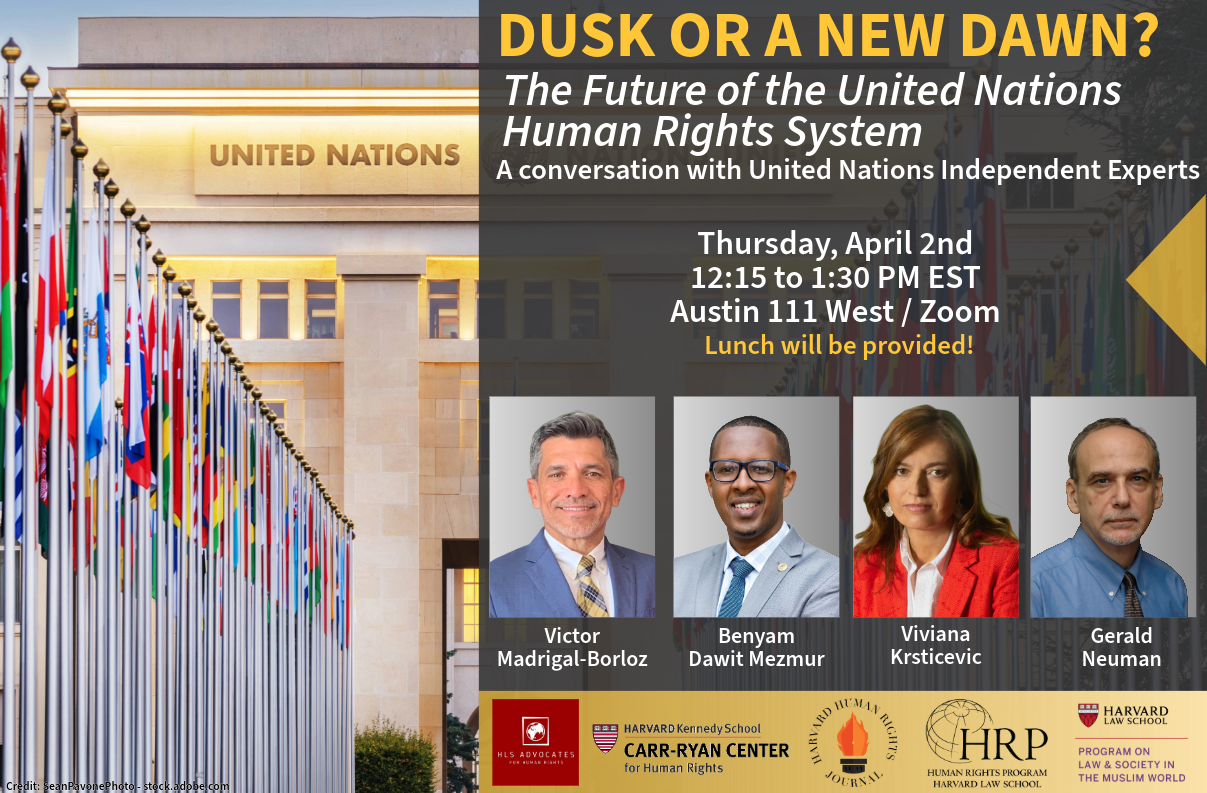
Lunch will be provided!
Panelists
Viviana Krsticevic is a member of the Independent International Fact-Finding Mission on the Islamic Republic of Iran. She is also the Executive Director of the Center for Justice and International Law (CEJIL) and regularly teaches at the American University Washington College of Law. She has appeared before the Inter-American Commission and Court of Human Rights, arguing pioneering cases on the legal framework for accountability, gender-based violence, civic space, victims’ rights, indigenous peoples, reparations, and social and economic rights.
Benyam Dawit Mezmur is a Professor of Law at the University of the Western Cape in Cape Town, South Africa and is Head of the Children’s Rights Project at the Dullah Omar Institute. He has served on the United Nations Committee on the Rights of the Child since 2012, and was its Chairperson from 2015-2017. He also served on the African Committee of Experts on the Rights and Welfare of the Child, a treaty body of the African Union, from 2010-2021, and served as its Chairperson twice from 2012-2014 and 2015-2017.
Victor Madrigal-Borloz is a moderator and member of the Board of Trustees of the United Nations Voluntary Fund for Victims of Torture and a Distinguished Visiting Researcher at the Williams Institute of the University of California in Los Angeles (UCLA) . From 2013 to 2016 he was a member of the UN Subcommittee on the Prevention of Torture, and from 2018 to 2023 he held the mandate of UN Independent Expert on Protection against violence and discrimination based on sexual orientation and gender identity.
Gerald Neuman (moderator) is the Director of Harvard Law School’s Human Rights Program, and the J. Sinclair Armstrong Professor of International, Foreign, and Comparative Law at HLS. Neuman teaches courses in international human rights law, immigration and nationality law, and U.S. constitutional law. From 2011 to 2014, he served as a Member of the UN Human Rights Committee. Neuman holds a JD from HLS and a PhD from the Massachusetts Institute of Technology.
This event is co-sponsored by Harvard Law School’s Human Rights Program, the Program for Law and Society in the Muslim World, the Carr-Ryan Center for Human Rights, and the Harvard Human Rights Journal.